
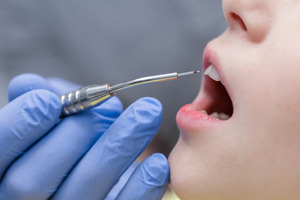
Technology has changed the way that dentists perform frenectomies to treat lip and tongue tie. In the past, the procedure had to be carried out with traditional dental instruments. Nowadays, however, many dentists are instead using state-of-the-art soft tissue lasers for this treatment, which has all sorts of benefits for their patients. Below is a brief overview of laser frenectomies and the advantages they offer.
How Do Laser Frenectomies Work?
Soft-tissue lasers can emit highly concentrated beams of light set at a specific wavelength. By aiming the laser at the soft tissues in a patient’s mouth, a dentist can make incisions without the need for a scalpel.
During a laser frenectomy, the goal is to address the overly restrictive tissue that is limiting tongue or lip movement. The laser can be used to gently remove the unneeded tissue, thus getting rid of the source of the problem and allowing for freer tongue and lip mobility.
What are the Benefits of a Laser Frenectomy?
Some of the advantages associated with frenectomies performed with soft-tissue lasers include:
- Increased Precision: Compared to traditional dental instruments, a laser is more precise, which makes it easier for the dentist to avoid removing more tissue than they need to.
- More Comfortable Procedures: Soft-tissue lasers are known to cause very little discomfort, and they can even eliminate the need for local anesthetic.
- Less Bleeding: The energy from the laser can immediately seal off any blood vessels that are exposed during the frenectomy. As a result, you can expect there to be less bleeding at the end of the procedure.
- Faster Recovery Times: Patients often experience shorter recovery times after a laser frenectomy. This can be largely attributed to the less invasive nature of the treatment.
- High Success Rates: The vast majority of laser frenectomies are successful, and it’s rare for retreatment to be needed later on.
Is a Laser Frenectomy Right for You or Your Loved Ones?
If you or someone in your family is struggling with a lip or tongue-tie, it’s generally best to have a frenectomy performed as soon as possible. As such, it’s important to be able to recognize the warning signs of an overly restricted lip or tongue. In infants, this can include difficulty breastfeeding and slow weight gain. Older children and adults might have issues with speaking and chewing.
In the event that a frenectomy is needed, you should do your research before choosing a practice for the job. If you want to ensure that the treatment is as comfortable as possible, then it’s worth seeking out a dentist who offers laser frenectomies.
About the Author
Dr. Jesse Witkoff is a board-certified pediatric dentist who has well over 40 years of experience. He studied pediatric dentistry at the University of Medicine and Dentistry of New Jersey. He is a founding member of the International Consortium of Ankylofrenulo Providers, and he holds membership with the Academy of Laser Dentistry. At Rocky Mountain Tongue Tie, he offers precise, comfortable laser frenectomies. If you’re looking for an expert in treating lip and tongue-ties, you can schedule an appointment with Dr. Witkoff at his Boulder practice by visiting his website or calling (720) 743-3340.